JB Hi-Fi to refund consumers after allegedly misleading “was/now” pricing
- Lianne
- Jun 18
- 3 min read
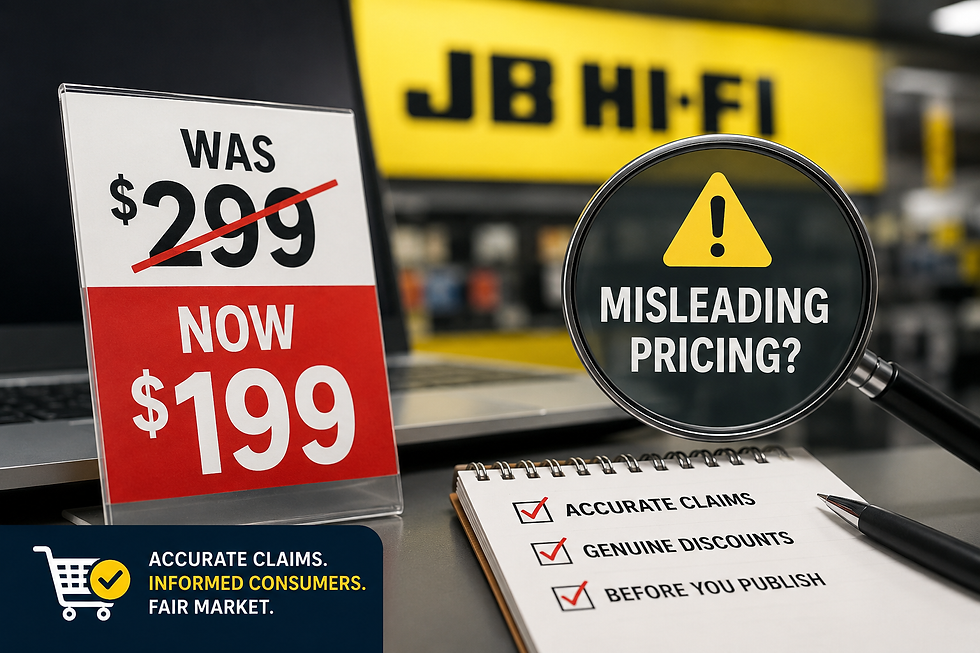
JB Hi-Fi Group has commenced a process to refund more than $250,000 to approximately 200 consumers after the ACCC raised concerns that the company may have misled consumers with pricing claims in advertisements for several products, including laptops, a VR headset and a gaming monitor.
The ACCC monitored JB Hi-Fi’s online product pricing from March to September 2025 and raised concerns that some promotional pricing claims may have created a misleading impression about the level of savings available.
The ACCC alleged that JB Hi-Fi promoted 17 products as discounted from a previous higher price when the products were either:
never offered for sale at the higher “was” price;
only offered at that higher price for a short period; or
only offered at that higher price long before the promotion.
ACCC Commissioner Luke Woodward said “Businesses must not mislead consumers with incorrect pricing displays, including listing incorrect ‘was’ prices when advertising promotions, whether online or in store.”
The ACCC stated that JB Hi-Fi’s conduct may have deprived consumers of the opportunity to make informed purchasing decisions based on accurate information, as consumers may have made different purchasing decisions if they knew the claimed discount was not genuine.
A total of 206 consumers purchased products advertised with the allegedly misleading “was” prices.
While JB Hi-Fi advised the issues were the result of system and human errors, the ACCC emphasised that businesses are responsible for ensuring pricing information is accurate and that advertised discounts represent genuine savings.
WHAT DOES THIS MEAN FOR ADVERTISERS AND PUBLISHERS?
This decision is an important reminder that advertising claims must reflect the overall impression created for consumers.
For advertisers, any objective claim made in advertising should be accurate, not misleading and capable of being substantiated.
For publishers, the focus is not on independently verifying every claim made by an advertiser but recognising claims that may require additional consideration or confirmation before publication.
Publishers should pay particular attention to claims such as:
price comparisons (“Was/Now”, “Save X%”, “Normally $X”)
performance or effectiveness claims
“No.1”, “best”, “leading” or superiority claims
guarantees or promises of a particular outcome
claims based on studies, statistics or research
testimonials or consumer experiences
Where a claim is specific, measurable or likely to influence a consumer’s decision, consider whether the advertiser has confirmed the claim can be supported.
Advertisers should carefully consider:
Savings claims must be accurate
Consumers are influenced by the perception of a bargain. If the advertised saving appears greater than the real saving available, the claim may mislead consumers even if the current selling price itself is correct.
“Was/now” and comparison pricing
Claims such as:
Was $299 / Now $199
Save 40%
$100 off
Normally $X
Valued at $X
must be based on a genuine reference price.
The previous price should be one that the product was actually offered at for a reasonable period and should represent a meaningful comparison for consumers.
The overall impression matters
Advertisers should consider what a reasonable consumer would understand from the promotion.
Would they believe:
this is a genuine limited-time saving?
the product was recently sold at the higher price?
they are receiving a larger discount than they actually are?
If the impression does not match reality, the advertising may create risk under the Australian Consumer Law.
Systems and errors are not a complete defence
The ACCC acknowledged that the pricing issues were largely caused by human and system errors. However, businesses are still expected to have appropriate processes in place to ensure advertising claims are accurate before publication.
KEY TAKEAWAY
Before publishing price promotions or savings claims, consider:
“Does the advertising create a clear impression about the value of the offer, and has the advertiser confirmed they can support that claim?”
Publishers are not expected to independently verify an advertiser’s pricing history or substantiate every savings claim. However, claims such as:
“Was/Now” pricing
“Save X%”
“Normally $X”
“Valued at $X”
“Worth over $X”
should be treated as objective claims that the advertiser must be able to support.
If a claim appears unusual, exaggerated or unclear, consider seeking confirmation from the advertiser that appropriate substantiation is held.
A discount claim is not just about the final price it is about the overall impression created about the value of the offer.
PUBLISHER TAKEOUT
Publishers are not expected to verify an advertiser’s pricing history, but savings claims are objective advertising claims. If a discount, “was/now” price or value claim appears unclear or unusually strong, consider checking that the advertiser holds appropriate support before publication.


Comments